How to Prevent Warranty Fraud in the AI Era (2026 Guide)
TL;DR
Warranty fraud costs brands an estimated $25 billion every year, and AI has made the problem worse. Fraudsters now generate photorealistic fake receipts, fabricate product damage photos, and build synthetic customer identities in seconds.
The most effective approach is prevention at the registration layer. When every product is tied to a verified owner through QR-based registration, serial validation, and proof of purchase capture before any claim is filed, the highest-volume fraud types (serial reuse, fake receipts, unregistered product claims) get blocked at the source.
Dyrect's digital warranty management platform handles this end-to-end: registration, serial validation, digital warranty cards, and automated claims eligibility. It gives brands a single system to prevent fraud while keeping the experience seamless for real customers.
What used to take a fraudster an hour, forging a receipt, faking a damage photo, now takes 30 seconds. AI-generated fake receipts went from 0% to 70.8% of all flagged fraud documents in just 14 months. Warranty fraud prevention in 2026 is a fundamentally different challenge than it was two years ago.
The old playbook of manual claim reviews and gut-feel approvals can't keep up. Fraudsters now use generative AI to create photorealistic thermal-paper receipts, submit doctored images of "damaged" products, and spin up synthetic customer identities at scale. Meanwhile, legitimate customers get caught in the crossfire when your team tightens approvals out of fear.
This guide covers every fraud type your brand faces today, the new AI-powered tactics reshaping the threat, the detection methods worth investing in, and the step-by-step prevention system that stops fraudulent warranty claims before payout. Whether you're processing 50 claims per month or 5,000, the framework works the same way.
What Is Warranty Fraud?
Warranty fraud happens when someone intentionally misrepresents facts to receive warranty benefits they're entitled to under your brand's terms. The legal definition varies by market, but the operational definition stays consistent.
Three conditions make a warranty claim fraudulent:
The claim misrepresents a fact. The customer says the product failed under normal use. In reality, they dropped it.
The misrepresentation is material. It changes the outcome of the claim decision.
Your brand acts on it. The fraud completes when the payout, replacement, or credit goes out.
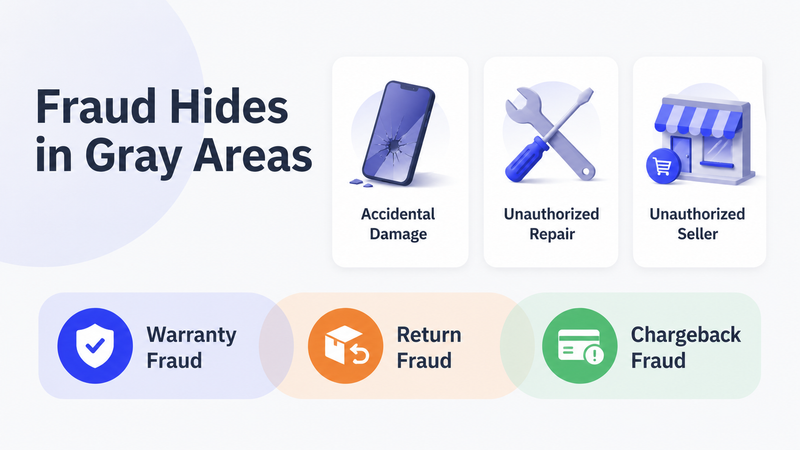
Here's what makes warranty fraud especially difficult to manage: most of your losses come from gray-area cases, rather than obvious fakes. Accidental damage claimed as manufacturing defects. Unauthorized repairs repackaged as warranty-eligible issues. Products bought through unauthorized sellers submitted under your brand's official warranty.
Your claims team faces these judgment calls daily. Without clear validation systems, gray-area calls trend toward approval because your team would rather err on the side of customer satisfaction. Fraudsters know this, and they exploit the approval bias systematically.
Warranty fraud vs. return fraud vs. chargeback fraud: these three overlap but differ in mechanics. Return fraud exploits your return policy (wardrobing, empty box returns, counterfeit swaps). Chargeback fraud uses the bank dispute process to reverse legitimate charges. Warranty fraud specifically targets your warranty program, claiming benefits for repairs, replacements, or credits under warranty terms. Many organized fraud operations hit all three simultaneously.
How Much Does Warranty Fraud Cost Brands in 2026?
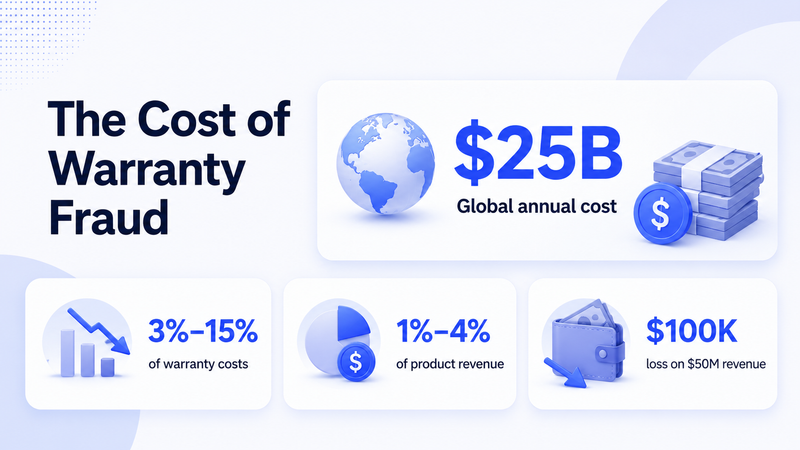
Industry estimates put the annual cost of fraudulent warranty claims at $25 billion globally. For individual brands, the math is stark: 3% to 15% of total warranty costs are attributed to fraud, depending on your product category and sales channels.
For context, warranty costs typically run 1% to 4% of total product sales revenue. If your brand does $50 million in annual revenue with a 2% warranty cost ($1 million), and 10% of those claims are fraudulent, you're losing $100,000 per year on warranty fraud alone. Scale that to a billion-dollar brand, and the losses reach $30 to $50 million annually when you include direct costs, operational overhead, and brand damage.
But the claim payout is the smallest part of the real cost. Here's where warranty fraud actually bleeds your brand:
Direct payout cost. Refunds, replacements, and repairs on illegitimate claims.
Operational cost. Every fraudulent claim consumes agent time, quality review cycles, and management attention. Your claims team spends hours investigating instead of serving real customers.
Inventory disruption. Fraudulent replacement shipments mess with your stock levels, especially on high-demand SKUs. You're sending products to fraudsters while legitimate customers wait.
False positive damage. When fraud rates climb, your team starts denying legitimate claims out of suspicion. Real customers get punished for the behavior of bad actors, and they take their frustration to social media and review platforms.
Brand trust erosion. Customers who experience a slow, suspicious, or denied warranty process lose faith in your brand. PwC research shows customers are more inclined to buy from brands with superior post-sales experiences. The inverse is equally true.
12 Types of Warranty Fraud Every Brand Should Know
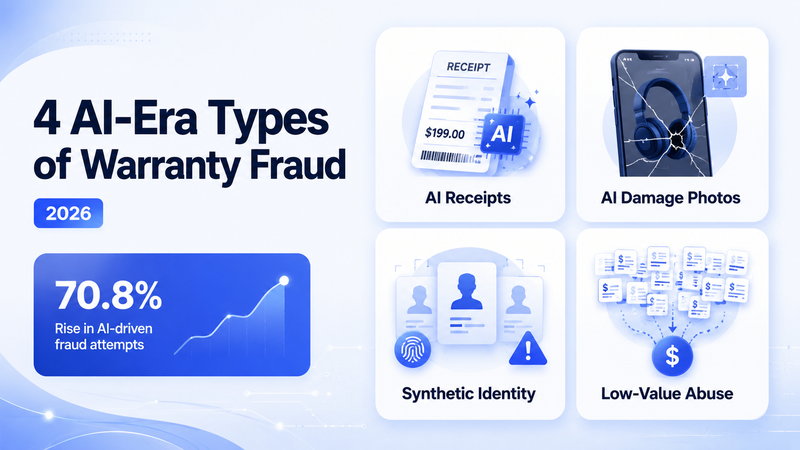
Understanding the full taxonomy matters because each fraud type requires a different detection and prevention approach. Here are the eight classic types and four AI-era additions your brand faces in 2026.
1. False Defect Claims
The customer says the product failed. It didn't. The item works perfectly fine, but the customer wants a free replacement or refund. This is the most common type of warranty fraud and the hardest to detect without photo or video evidence requirements at claim intake.
Red flag: Claims submitted with vague descriptions like "stopped working" and zero supporting documentation.
2. Serial Number Tampering and Reuse
Fraudsters remove, alter, or duplicate serial numbers to make ineligible products appear warranty-eligible. The same serial might show up across multiple customer accounts, or a serial from a genuine product gets applied to a counterfeit unit.
Red flag: The same serial number appearing in claims from different customers, different regions, or different purchase dates.
3. Return Swap Fraud
The customer files a warranty claim, receives a replacement, and returns the "defective" unit. Except the returned unit is counterfeit, a different (older) product, or has been stripped of valuable components. The fraud closes when nobody checks the returned unit's serial against the original case record.
Red flag: Returned units with mismatched serial numbers, missing components, or different manufacturing dates than the original claim.
4. Backdated Purchase Fraud
Fraudsters edit receipts or invoices to change the purchase date, making an expired warranty appear active. This was already common with basic Photoshop edits. In 2026, it's dramatically easier (more on that in the AI section below).
Red flag: Purchase dates that cluster suspiciously close to the oldest eligible date for warranty coverage.
5. Intentional Damage Near Warranty Expiry
The customer deliberately damages a product in the final weeks of warranty coverage to get a free replacement. The new replacement comes with a fresh warranty, effectively extending their coverage indefinitely.
Red flag: Unusual spikes in claims submitted within the last 30 days of warranty windows.
6. Gray Market and Unauthorized Channel Claims
Products bought through unauthorized resellers, gray market channels, or liquidation outlets get submitted under your brand's official warranty. The customer may have paid a fraction of retail price and expects full warranty service.
Red flag: Claims from customers whose purchase channel or region doesn't match your authorized distribution network.
7. Service Center and Dealer Collusion
Your own service network becomes the fraud vector. Service centers bill for repairs that didn't happen, inflate labor hours, replace parts that were functioning fine, or collude with customers to split the payout.
Red flag: Individual service centers with claim rates significantly above the network average, or repeated high-value repairs on the same product categories.
8. Supplier-Side Fraud
Suppliers inflate defect rates in chargeback files, submit duplicate claims, or substitute lower-grade components while billing at original-spec prices. This is the most expensive fraud type because your brand depends on the supplier's own data for chargeback validation.
Red flag: Defect rates from a specific supplier that don't match your internal quality data, or chargeback values that consistently exceed expected ranges.
9. AI-Generated Receipt and Invoice Fraud (New in 2025-2026)
This is the fastest-growing fraud type in 2026. Fraudsters use generative AI tools like ChatGPT, Gemini, or dedicated image generators to create photorealistic purchase receipts and invoices from scratch. These fakes include thermal paper textures, realistic creases, camera blur, and accurate merchant formatting.
AppZen platform data shows AI-generated fake receipts accounted for 0% of flagged fraudulent documents in March 2025. By mid-May 2026, that figure reached 70.8%, based on 1,471 AI-generated fakes from 745 individuals at 174 companies.
Red flag: Receipts with perfect formatting but subtle inconsistencies in merchant details, tax calculations, or font rendering. Receipts submitted as images rather than forwarded order confirmation emails.
10. AI-Manipulated Product Damage Photos (New in 2025-2026)
Instead of actually damaging a product, fraudsters use AI image editors to add realistic cracks, stains, mold, or malfunctions to photos of perfectly functional items. Brands like Boll & Branch and Bogg have reported surges in AI-doctored damage images submitted as warranty evidence.
Returns abuse driven by AI-doctored images increased 15% in the second half of 2025 alone, and the same tactic applies directly to warranty claims that require photo documentation.
Red flag: Damage patterns that look visually perfect but inconsistent with how the product's materials actually fail. Multiple claims from different customers with strikingly similar damage images.
11. Synthetic Identity Fraud (New in 2025-2026)
Fraudsters build entirely fabricated customer profiles, combining real and fake identity elements, to file warranty claims at scale. AI tools automate everything from account creation to behavioral patterns across browsing, purchasing, and post-purchase interactions.
One documented fraud ring caused an estimated $4.2 million in losses within 48 hours using synthetic identities, spoofed devices, and automated transaction flows reaching 180 per minute.
Red flag: Clusters of new customer accounts with similar registration patterns, device fingerprints, or shipping addresses.
12. Low-Value Threshold Exploitation (New in 2025-2026)
Fraudsters deliberately keep individual claim values small, typically around $100, to stay below auto-approval thresholds. Each claim looks harmless in isolation. But across hundreds or thousands of small claims filed by a fraud ring, the cumulative losses are massive.
Red flag: High volume of small-value claims from accounts with limited purchase history or minimal brand engagement.
How AI Has Changed Warranty Fraud in 2025-2026
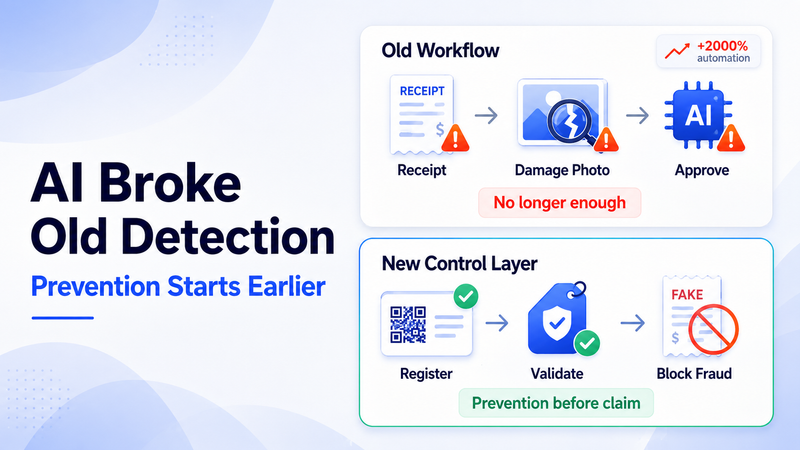
The AI shift deserves its own section because it represents a structural change, rather than an incremental one.
Before AI (pre-2024), warranty fraud required effort. Forging a receipt meant Photoshop skills and time. Faking product damage meant physically altering the item. Running multiple claims meant creating and managing separate identities manually. The effort itself acted as a natural deterrent.
After AI (2025-2026), the effort barrier collapsed. Here's what changed:
Receipt generation became instant. Generative AI tools produce thermal-paper receipts with realistic textures, creases, and camera blur in seconds. Free tools like ChatGPT and Google Gemini handle this with a simple prompt. The fakes are so convincing that one ICAEW expert noted even trained reviewers struggle to distinguish them from originals.
Damage documentation became fabricated. AI image editors create convincing photos of product damage: cracks on screens, water stains on fabrics, mold on surfaces, broken components. Brands across consumer products are reporting these in warranty claim submissions.
Identity creation became scalable. Synthetic identity tools generate complete customer profiles with matching email addresses, phone numbers, shipping addresses, and behavioral patterns. Fraud rings use these to file claims across multiple accounts simultaneously.
The volume game shifted. Agentic AI tools, automated systems designed to execute multi-step workflows, now handle the entire fraud chain: create account, simulate purchase behavior, file claim, submit generated evidence. Over the second half of 2025, agentic activity surged by over 2,000%.
The detection problem fundamentally changed. When fraud artifacts (receipts, photos, identities) are AI-generated, the signals your team traditionally looked for disappear. Pixel-level inconsistencies in edited receipts become irrelevant when the receipt was generated from scratch. Metadata checks fail when the image was created by AI rather than captured by a camera.
For warranty teams, this means the old process of "review the receipt, check the photo, approve the claim" is broken. Prevention at the point of product registration, before any claim is filed, becomes the critical control layer.
How to Detect Warranty Fraud: 3 Methods Compared
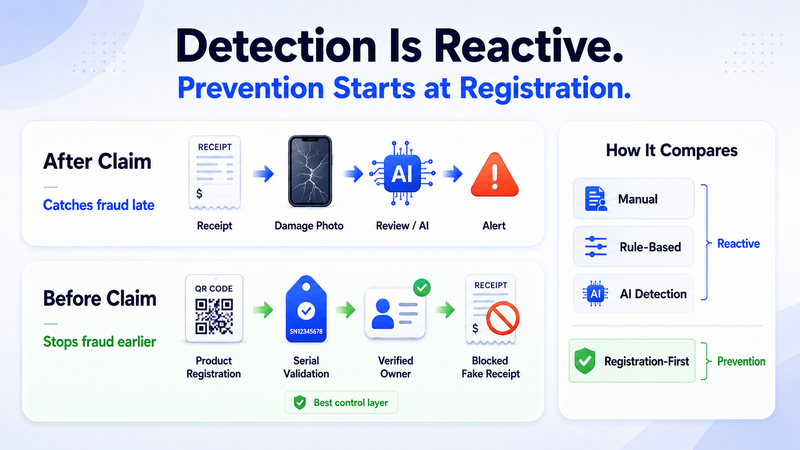
Every brand sits somewhere on the detection maturity curve. Here's what each level catches, what it misses, and when it makes sense.
Manual Review: What It Catches and What It Misses
Manual review means your claims agents visually inspect receipts, read claim descriptions, and use judgment to approve or deny. It catches obvious fakes: clearly photoshopped receipts, claims on products you've discontinued, or customers who call in with stories that contradict their submitted documentation.
What it misses: patterns across claims. The human reviewer sees each claim in isolation. They can't spot that the same serial number showed up in three different claims this month, or that 40 claims from the same zip code all arrived in the same week. Manual review also fails completely against AI-generated evidence because the fakes look legitimate at the individual claim level.
Best for: Very small brands processing fewer than 50 claims per month.
Rule-Based Systems: The 15-25% Ceiling
Rule-based detection applies predefined flags: duplicate serial numbers, claims exceeding a dollar threshold, claims filed within X days of purchase, or multiple claims from the same email address. These catch structured, pattern-matching fraud.
The problem: rule-based systems catch 15 to 25% of fraud at best. They miss AI-generated receipts (which pass format checks), synthetic identities (which don't trigger duplicate-email rules), and coordinated low-value attacks (which stay below dollar thresholds by design).
Rules also generate false positives. Legitimate customers who file two claims in a year get flagged alongside actual fraudsters, creating friction that damages the real customer relationship.
Best for: Mid-size brands with defined warranty policies and moderate claim volume.
AI-Powered Detection using solutions like Dyrect: Reaching the 60-75% Catch Rate
AI-powered detection analyzes patterns across your entire claim history: customer behavior over time, geographic clustering, claim timing relative to purchase and warranty expiry, image analysis for AI-generated artifacts, and cross-referencing across customer accounts.
Where rule-based systems check individual data points, AI detection checks relationships between data points. It identifies that three "different" customers all share a device fingerprint, that a cluster of claims from one region uses suspiciously similar language, or that submitted photos contain generative AI metadata.
AI-powered detection reaches 60 to 75% fraud identification rates by analyzing patterns across customers, geographies, and time, rather than validating claims one by one.
Best for: Brands at scale processing hundreds or thousands of claims monthly.
The Real Comparison
The fourth row matters most. Detection, regardless of method, is reactive. It catches fraud after the claim is filed. Prevention at the registration layer stops fraud before the claim ever enters your system.
The 5-Layer Warranty Fraud Prevention Framework
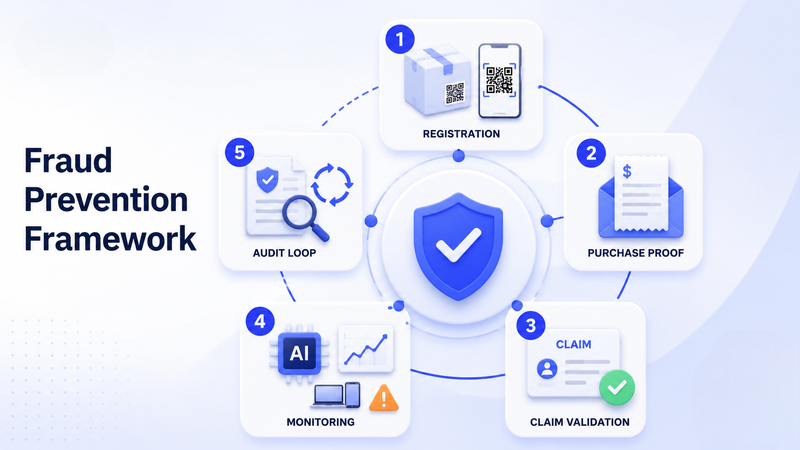
Detection catches fraud after it happens. Prevention stops it before the payout. Here's the five-layer system that works.
Layer 1: Product Registration at Point of Purchase
This is the most underused anti-fraud layer in warranty management. When you require product registration before warranty activation, you create a verified link between the product (via serial number), the buyer (via identity), and the purchase (via proof of purchase), all captured at the moment of peak engagement.
Every claim filed later gets validated against this registration record. If the product was registered by Customer B, and Customer C files a warranty claim on the same serial, the system flags it immediately.
How to implement it: Use QR codes on product packaging for offline and marketplace buyers. Embed a registration widget on your ecommerce store for direct buyers. Capture name, email, phone, purchase channel, and proof of purchase at registration. Validate the serial number at scan to block duplicates and counterfeits.
Layer 2: Proof of Purchase Verification
Require invoice or order confirmation upload at the point of registration, rather than at the point of claim. When proof of purchase is captured early, your system has a baseline to compare against. If a claim later arrives with a different receipt, or with an AI-generated receipt for a different purchase date, the discrepancy surfaces instantly.
Key detail: Accept forwarded order confirmation emails or direct retailer integrations over screenshot uploads. Screenshots are the easiest documents to forge. Forwarded emails carry header metadata and are significantly harder to fake.
Layer 3: Claim Intake Validation
When a registered customer files a claim, validate three things before any human review:
Serial match. Does the serial on the claim match the serial on the registration record?
Warranty status. Is the product still within the warranty window based on the original registration date?
Evidence requirements. Has the customer submitted the required photos, videos, or description that meet your policy's documentation standards?
Claims that pass all three move to standard processing. Claims that fail any check get routed to a review queue with the specific discrepancy flagged. This keeps legitimate claims flowing fast while isolating suspicious ones.
Layer 4: Pattern Monitoring Across Claims
Even with strong registration and intake validation, sophisticated fraudsters adapt. Pattern monitoring watches for signals across your entire claim database:
Same serial number across multiple accounts
Claim frequency from individual customers exceeding normal rates
Geographic clustering of claims in specific regions or zip codes
Timing patterns (bulk claims filed within the same narrow window)
Language similarity across claim descriptions from different customers
Device or IP address overlap across "different" customer accounts
Pattern monitoring is where AI-powered detection earns its value. The signals above are invisible in individual claim review but obvious when analyzed at scale.
Layer 5: Policy Enforcement and Audit Loop
Your warranty policy is the legal foundation of your fraud prevention system. Every layer above enforces rules defined in your policy. The audit loop ensures those rules stay current.
Run quarterly audits of claim data to identify:
New fraud patterns your current rules miss
Policy gaps that fraudsters exploit (e.g., missing exclusions for gray market products)
False positive rates that punish legitimate customers
Service center or dealer anomalies
Update your policy, registration requirements, and detection rules based on what each audit reveals. Fraud tactics evolve, and your system has to evolve with them.
How QR-Based Warranty Registration Stops Fraud Before It Starts
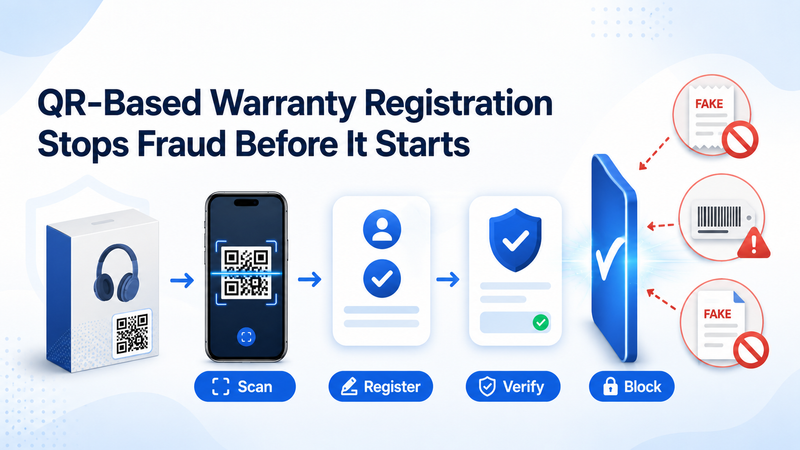
Every detection method discussed above kicks in after a claim is filed. The structural advantage of registration-first warranty management is that it prevents fraud upstream, at the moment the customer scans the QR code, before any claim enters your system.
Here's howDyrect's product registration software makes this work for consumer product brands:
QR Code Registration That Captures Every Buyer
Dyrect places a unique QR code on every product's packaging. When a customer scans it with their smartphone, they land on a branded warranty registration page where they enter their details, upload proof of purchase, and activate their warranty. This works for every sales channel: direct ecommerce, Amazon, retail stores, or marketplace purchases.
The moment registration completes, Dyrect creates a verified ownership record: this specific customer, bought this specific product (validated by serial number), from this specific channel, on this specific date.
Every warranty claim filed later gets checked against this record. If the registration doesn't exist, or the serial doesn't match, or the claimant differs from the registered owner, the system flags the discrepancy before any payout is considered.
AI-Powered Serial Number Validation
Dyrect's serial validation uses AI to detect duplicates, counterfeits, and tampering at the point of registration, rather than at the point of claim. If someone tries to register a serial that's already been registered, or enters a serial that doesn't match your product database, the registration fails immediately.
This kills serial reuse fraud, counterfeit claims, and gray market warranty exploitation at the earliest possible point.
Digital Warranty Cards Replace Forgeable Paper
Physical warranty cards get lost, copied, or forged.Dyrect's digital warranty cards are generated automatically at registration, tied to the customer's verified identity and serial number, and stored digitally. There's nothing to lose, nothing to photocopy, and nothing to fake.
Claims Eligibility Tied to Registration
When a customer files a warranty claim through Syrect’s claims management system, the platform validates the claim against the registration record in real time. Serial match, warranty window, ownership verification, and evidence requirements are all checked automatically. Legitimate claims flow through fast. Suspicious claims get flagged with specific reasons.
The result: brands using registration-first systems see fraud rates drop significantly because the system eliminates the most common fraud vectors (serial reuse, fake receipts, unregistered products, counterfeit claims) before any human review is needed.
Gurumukh Uttamchandani, Executive Director at Syska LED Lights, shared: "They have helped us a big way in implementing paperless warranty claims processing solutions for our brand. They have great technology, and the implementation and integration set up was really quick."
Dyrect's platform stats: 4 million+ warranties registered. 100,000+ warranty claims processed. Rated 5 stars on Shopify and 4.8 stars on G2 with multiple badge wins.
How to Write a Fraud-Resistant Warranty Policy
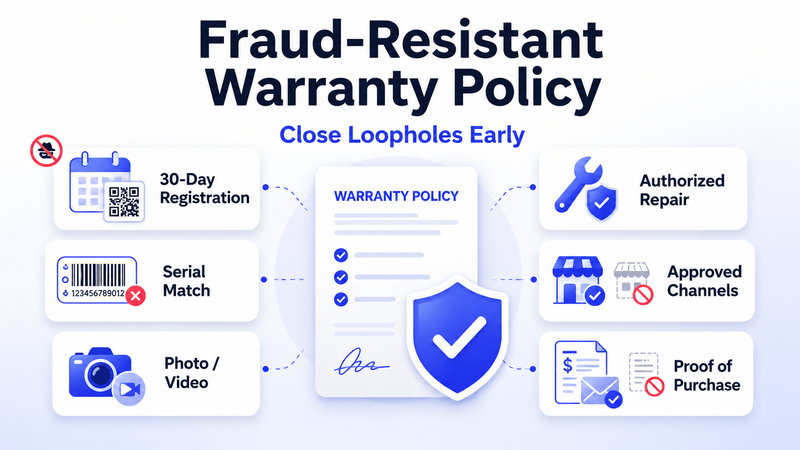
Your warranty policy is the document your claims team, your customers, and (if it comes to it) your legal team all rely on. Vague policies invite abuse. Specific policies close loopholes. Here are the components every fraud-resistant warranty policy should include:
Mandatory registration window. Require product registration within 30 days of purchase to activate warranty coverage. This creates a clean ownership record and blocks backdated claims filed months later.
Serial number requirement at claim. Every claim submission should require the product's serial number. If the serial doesn't match a registered product, the claim routes to manual review.
Photo and video evidence standards. Specify what documentation you require for different claim types. Cosmetic damage might need three photos from different angles. Functional failures might need a short video demonstrating the issue. Define these per product category in your policy.
Explicit exclusion for unauthorized repairs. If a customer takes the product to an unauthorized service center, warranty coverage ends. State this clearly, and require service history disclosure at claim time.
Gray market and unauthorized channel exclusion. Define which sales channels your warranty covers. If you sell through authorized retailers and your own website, state that products purchased through unauthorized third parties are excluded from warranty.
Claim frequency limits. Set maximum claim frequency per customer per product. If a customer files three claims on the same product in six months, the system should escalate for review.
Proof of purchase specifications. Define what counts as valid proof: forwarded order confirmation emails (preferred), retailer-issued invoices, or receipts. Explicitly state that screenshots of receipts may require additional verification.
Modification and accidental damage exclusion. Clearly state that damage resulting from customer modification, unauthorized repair, accidental drops, water exposure, or use outside the product's intended purpose falls outside warranty coverage.
8 Red Flags Your Brand Is Being Defrauded Right Now
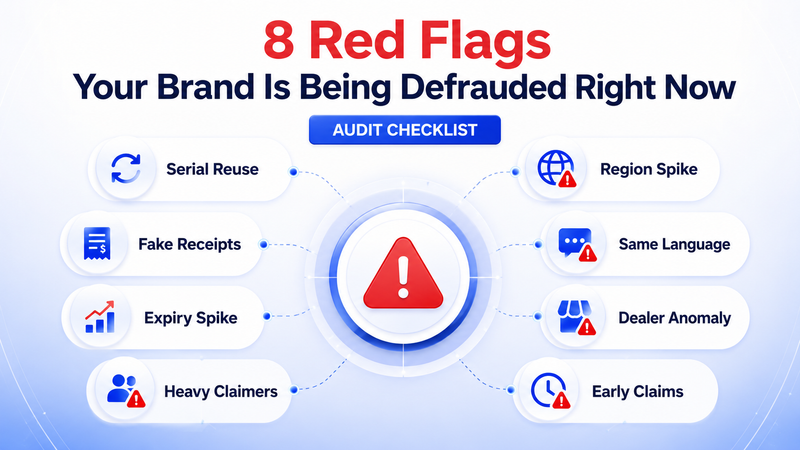
Use this as an audit checklist. Pull your last 90 days of warranty claims and check:
1. Same serial numbers appearing across multiple claims or customer accounts. This signals serial reuse or counterfeit product claims. If your system doesn't validate serials at registration and claim, you're exposed.
2. Receipts submitted as screenshots rather than forwarded emails. Screenshots are the easiest documents to forge, especially with AI tools. If more than 40% of your proof-of-purchase submissions are image screenshots, you have a verification gap.
3. Claim spikes in the final 30 days of warranty windows. Intentional damage fraud clusters near expiry dates. Compare claim timing distribution against your warranty period to see if the pattern exists.
4. Disproportionate claims from a small group of customers. If 5% of your customer base generates 30%+ of warranty claims, investigate those accounts.
5. High claim rates from specific geographic regions. Geographic clustering, especially in regions where your authorized distribution is limited, can signal organized fraud or gray market exploitation.
6. Claims with identical or near-identical language. Fraud rings often use templates or scripts for claim submissions. Run a simple text similarity check across recent claims.
7. Service centers with claim rates far above network average. If one service center processes 3x the claims of comparable locations, the discrepancy warrants an audit.
8. Claims filed within days of purchase. While genuine defects do occur early, an unusual volume of claims filed within the first week of purchase often signals fraudulent intent.
If three or more of these flags show up in your data, your warranty program likely has a fraud problem worth addressing systematically.
Frequently Asked Questions About Warranty Fraud
What is warranty fraud?
Warranty fraud occurs when someone intentionally misrepresents facts to receive warranty benefits they haven't earned. This includes filing claims for defects that don't exist, using tampered serial numbers to make ineligible products appear covered, submitting forged receipts to extend warranty windows, or returning counterfeit products while keeping the genuine item. The fraud completes when your brand approves the payout, ships the replacement, or issues the credit based on false information.
Is warranty fraud a crime?
Yes. Warranty fraud can be prosecuted as a criminal offense under consumer fraud, wire fraud, or theft-by-deception statutes depending on the jurisdiction. Federal cases prosecuted under the Wire Fraud Act can result in sentences of up to 20 years in prison, and fines reaching $250,000 or more. State-level charges typically carry penalties of one to ten years for felony-level fraud. Beyond criminal consequences, companies can pursue civil litigation to recover financial losses.
How much does warranty fraud cost businesses?
Industry estimates put the global cost at approximately $25 billion annually. For individual brands, fraudulent claims account for 3% to 15% of total warranty costs. For a brand doing $100 million in annual revenue with typical warranty costs of 2% ($2 million), a 10% fraud rate means $200,000 in direct losses per year, before counting operational overhead and brand damage.
How do I detect a fakewarranty claim?
Look for: serial numbers that appear in multiple claims or customer accounts, receipts submitted as screenshots (especially with perfect formatting), claims filed in the final days of warranty windows, identical language across different customer submissions, and claim volumes disproportionately concentrated among a small group of customers. AI-powered detection systems identify these patterns automatically across your full claim history.
Can AI detect warranty fraud?
Yes. AI-powered detection systems catch 60 to 75% of fraudulent claims by analyzing patterns across customers, geographies, and time periods. This significantly outperforms rule-based systems (15 to 25% detection) and manual review. AI excels at spotting cross-claim patterns, image manipulation, behavioral anomalies, and coordinated fraud ring activity that human reviewers and simple rules miss.
How do fraudsters use AI to commit warranty fraud?
In 2025-2026, fraudsters use generative AI to create photorealistic fake receipts (complete with thermal paper textures and camera blur), fabricate product damage photos, generate synthetic customer identities at scale, and automate entire claim submission workflows. AI-generated fake receipts went from 0% to 70.8% of flagged fraudulent documents between March 2025 and May 2026, making this the fastest-growing fraud vector.
How do QR codes prevent warranty fraud?
QR codes on product packaging create a verified registration record at the moment of purchase. When a customer scans the code, the system captures their identity, validates the serial number, and records proof of purchase. Every subsequent warranty claim gets checked against this registration. If the product was registered by a different person, or the serial doesn't match, or the product was purchased through an unauthorized channel, the system flags the discrepancy before payout. Platforms likeDyrect automate this entire flow.
What should my warranty policy include to prevent fraud?
Include: mandatory registration within 30 days of purchase, serial number requirement at claim submission, photo/video evidence standards per product category, explicit exclusions for unauthorized repairs and accidental damage, gray market/unauthorized channel exclusions, claim frequency limits, and clear proof-of-purchase specifications that favor forwarded emails over screenshots.
What is the difference between warranty fraud and return fraud?
Warranty fraud targets your warranty program, claiming repairs, replacements, or credits under warranty terms using false information. Return fraud targets your return policy, including tactics like wardrobing (buy, use, return), empty box returns, and counterfeit swaps. Chargeback fraud uses the bank dispute process. In practice, organized fraud operations often exploit all three simultaneously.
What is the best software for warranty fraud prevention?
The most effective approach combines registration-first prevention (QR-based product registration with serial validation) with automated claims management. Dyrect's warranty management platform handles both: product registration captures verified ownership data at purchase, and the claims system validates every claim against that record automatically. This prevents fraud at the source rather than detecting it after the fact.
How can small brands prevent warranty fraud without enterprise budgets?
Start with the registration layer. Implement QR code registration on your product packaging with serial number validation and proof of purchase capture. This single step eliminates the highest-volume fraud types (serial reuse, fake receipts, unregistered product claims) without requiring AI analytics or dedicated fraud teams. Platforms like Dyrect offer plans for growing brands. Pair registration with a clear, specific warranty policy that closes the most common loopholes.
How often should I audit my warranty claims for fraud?
Run a full audit quarterly. Review claim timing distribution, serial number patterns, customer claim frequency, geographic clustering, and service center performance. Between audits, monitor your flagged-claim rate, the percentage of claims that trigger validation errors at intake. If this rate climbs above your baseline, investigate before the next scheduled audit.
Comments
Your comment has been submitted